Ceiling Paint vs Wall Paint
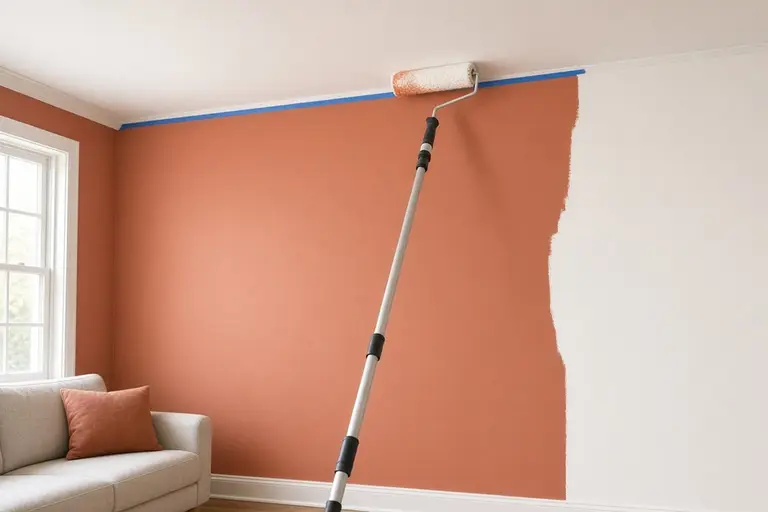
Ceiling paint is made for working overhead. Wall paint is made to stand up to hands, furniture and cleaning. You can use either on a ceiling, but they behave differently.
What's different about ceiling paint
Using Benjamin Moore's Waterborne Ceiling Paint as an example, its data sheet lists:
- An ultra-flat finish. Its sheen is rated 0–2 (at 85°), which is about as flat as paint gets. Flat paint hides bumps and roller marks, which matters on a big surface lit from the side by windows and lamps.
- Formulated for minimal spatter. Rolling overhead flicks paint down on you and the floor. Ceiling paints are built to cut that down.
- Extra open time so the paint stays workable longer and shows fewer lap marks.
- Not intended for areas subject to abrasion. That's the trade-off. Very flat paint isn't made to be scrubbed.
Why wall paint usually has more sheen
Walls get touched, bumped and wiped. Eggshell, satin and semi-gloss finishes clean up more easily than flat. On a ceiling, nobody touches it, so washability matters less and hiding flaws matters more.
PaintCare, a nonprofit that runs paint recycling programs, notes that as sheen goes down, coverage goes up. Flat paints generally need less paint to cover than semi-gloss or gloss.
Can I use wall paint on the ceiling?
Yes. A flat or matte wall paint works on a ceiling, and using one product for walls and ceiling (in the same color) means one can instead of two. What you give up is the spatter control and extra working time of a dedicated ceiling paint. Avoid glossy finishes overhead. They show every dent and roller line.
If the ceiling and walls are different colors or different products, estimate them separately so you buy the right amount of each.
Estimating ceiling area
A flat ceiling is just the floor area:
Ceiling area = length × width
A 12 × 12 room has a 144 sq ft ceiling. Tick Include ceiling for that room in the calculator and it adds the area for you.
Coverage on ceiling paint labels is similar to wall paint. The Benjamin Moore ceiling paint above lists 400–450 sq ft per gallon and calls for one or two coats. If you're repainting a white ceiling white, one coat may be enough. If it's stained or a new color, plan on two.
Vaulted or sloped ceilings are bigger than the floor. Measure each sloped surface (width × the length of the slope) and add them. See How to measure a room for paint for how to enter that.
Popcorn or heavily textured ceilings soak up more paint. PaintCare says rough textures can need up to 50 percent more. Try the 300 coverage preset or lower. Before painting a textured ceiling in an older home, read the lead note below.
Running ceiling and walls as separate estimates
If you're using a different product overhead:
- Run the walls as one project with Include ceiling off.
- Run the ceiling as a second project: same room sizes, Include ceiling on, and put a number larger than the wall area (say 1000) in Extra openings. The walls drop to zero, leaving only the ceiling. You'll see the "doors and windows exceed wall area" warning, which is expected here.
The simple way: ceiling gallons ≈ (length × width × coats ÷ coverage) × 1.10. For a 12 × 12 ceiling, two coats at 400 sq ft/gal: 144 × 2 ÷ 400 × 1.10 = 0.79 gallons, so one gallon.
What order to paint in
Ceiling first, then walls. Ceiling paint drips and spatters fall down, so anything that lands on the wall gets covered when you paint the walls. Cut in along the edge where the ceiling meets the wall, roll the ceiling, let it dry, then do the walls.
Older homes and textured ceilings
If your home was built before 1978, the US EPA says it's more likely to have lead-based paint. In Canada, Health Canada says homes built before 1990 may contain lead paint. Scraping or sanding can release lead dust. Test before you scrape anything overhead.
Every number here is an estimate. Check the label on your can.
Sources
- Benjamin Moore, Waterborne Ceiling Paint Ultra Flat (N508), Technical Data Sheet: https://media.benjaminmoore.com/WebServices/prod/assets/production/datasheets/TDS_0508/N508_TDS_US.pdf
- PaintCare, "Buy Right" (sheen and coverage; rough textures may need up to 50% more paint): https://www.paintcare.org/buy-right/
- US EPA, "Protect Your Family from Sources of Lead": https://www.epa.gov/lead/protect-your-family-sources-lead