How Many Coats of Paint Do You Need?
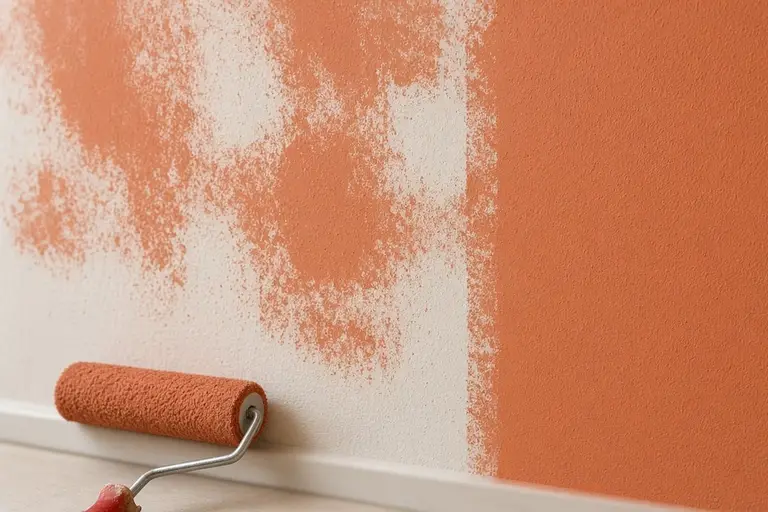
Plan on two. That's what the calculator starts with, and it's what the big paint makers recommend for most jobs. Here's when one is enough and when you need more.
Coats by situation
| Situation | Plan for |
|---|---|
| Same or similar color, wall in good shape | 1–2 coats |
| Noticeable color change | 2 coats |
| Big change (dark to light or light to dark) | Primer + 2 coats |
| New drywall or bare surface | Primer + 2 coats, or 2 coats of a self-priming paint rated for it |
| Patched spots | Spot-prime, then 2 coats over the whole wall |
| Ceiling, white over white | Often 1 coat |
| Stained or yellowed ceiling | Stain-blocking primer + 1–2 coats |
Why two coats is the default
Benjamin Moore's data sheet for its ben paint says that even when one coat looks close, it "recommends two coats to achieve full color development and to optimize performance." It adds that previously painted surfaces "can be finished with 1 or 2 coats," and bare surfaces need two.
Sherwin-Williams says something similar on its SuperPaint data sheet: priming and two coats "can help where hiding of a previous coating or application to new drywall is a factor."
When one coat can work
- You're refreshing the same color.
- The old paint is clean and sound.
- It's a ceiling going white over white.
Even then, keep a little paint for touch-ups. A one-coat plan with 10% waste usually leaves enough.
When you need more than two
- Deep or bright colors. Behr notes that a deep, intense color may need multiple coats or a tinted primer.
- Porous or rough surfaces. Behr also notes that porous, rough, textured or unpainted surfaces generally need more paint, as does a dramatic color change.
- Covering a dark color without primer. It may take extra coats. A tinted primer first is the other route, and often the simpler one. See Do I need primer?
"Paint and primer in one"
These products save you a separate primer step on many surfaces. They don't promise one coat. Benjamin Moore's own footnote says its paint-and-primer products are self-priming on most properly prepared surfaces but still recommends two coats. For stains, glossy surfaces or a huge color change, a dedicated primer still does a better job.
How coats change your gallons
Coats multiply the paint directly. For a 12 × 12 room with one door and two windows (334 sq ft of wall), at 350 sq ft/gal and 10% waste:
| Coats | Paint needed | Buy |
|---|---|---|
| 1 | 1.05 gal | 1 gallon + 1 quart |
| 2 | 2.10 gal | 2 gallons + 1 quart |
| 3 | 3.15 gal | 3 gallons + 1 quart |
At one coat, 1.05 gallons is right on the edge. If you'd rather not buy a quart for 0.05 gallons, set waste a bit lower and see where it lands. It's your call.
Wait between coats
Recoat times are on the label and vary by product, temperature and humidity. For example, Sherwin-Williams lists a 4-hour recoat time for SuperPaint at 77°F and 50% humidity, while Benjamin Moore lists 2 hours for ben. Cool or humid rooms take longer.
Set coats in the calculator under Coats (1 to 4). The result is an estimate, so check the label on your can.
FAQ
How many coats of paint do I need? Plan on two. Major paint makers such as Benjamin Moore recommend two coats for full color and durability on most jobs. Bare surfaces need two.
When is one coat of paint enough? One coat can work when you're refreshing the same color over clean, sound paint, or painting a ceiling white over white. Keep some paint for touch-ups.
Does paint and primer in one mean one coat? No. Paint-and-primer products can save a separate primer step on many surfaces, but makers like Benjamin Moore still recommend two coats.
How long should I wait between coats? Check the label. Recoat times vary by product, temperature and humidity. For example, Sherwin-Williams lists 4 hours for SuperPaint at 77°F and 50% humidity, and Benjamin Moore lists 2 hours for ben.
Sources
- Benjamin Moore, Ben Premium Interior Acrylic Paint & Primer, Matte (N624), Technical Data Sheet (two coats recommended; previously painted 1 or 2; recoat 2 hours): https://media.benjaminmoore.com/WebServices/prod/assets/production/datasheets/TDS_0624/N624_TDS_US.pdf
- Benjamin Moore, "How to Choose the Best Paint Primer" (paint-and-primer footnote): https://www.benjaminmoore.com/en-us/contractors/job-solutions/project-advice/choosing-best-paint-primer
- Sherwin-Williams, SuperPaint Interior Latex Semi-Gloss, Product Data Sheet (priming and two coats; recoat 4 hours): https://www.sherwin-williams.com/document/PDS/en/035777316627/
- Behr, "How much paint do I need?" (deep colors may need multiple coats or tinted primer; porous or rough surfaces need more): https://www.behr.com/how-to/exterior/how-much-exterior-paint-to-buy
- Behr, "Determine How Much Interior Paint to Buy" (250 to 400 sq ft per gallon with one coat): https://www.behr.com/how-to/interior/determine-how-much-interior-paint-to-buy
- Benjamin Moore, Waterborne Ceiling Paint (N508), Technical Data Sheet (one or two coats): https://media.benjaminmoore.com/WebServices/prod/assets/production/datasheets/TDS_0508/N508_TDS_US.pdf